CANSLIM is a growth stock selection method created by William O'Neil, founder of Investor's Business Daily. O'Neil studied every top-performing stock from 1880 to 2009 and distilled their shared traits into seven measurable criteria, one for each letter of the CANSLIM acronym.
He published the system in his 1988 book How to Make Money in Stocks, which has sold over 2 million copies. The method combines fundamental analysis (earnings, sales, institutional sponsorship) with technical analysis (price action, volume, market direction) into a single repeatable framework.
The system is evidence-based. Every criterion traces back to what winning stocks did before their biggest runs. Here is what each letter means and how to apply it.
Current Quarterly Earnings
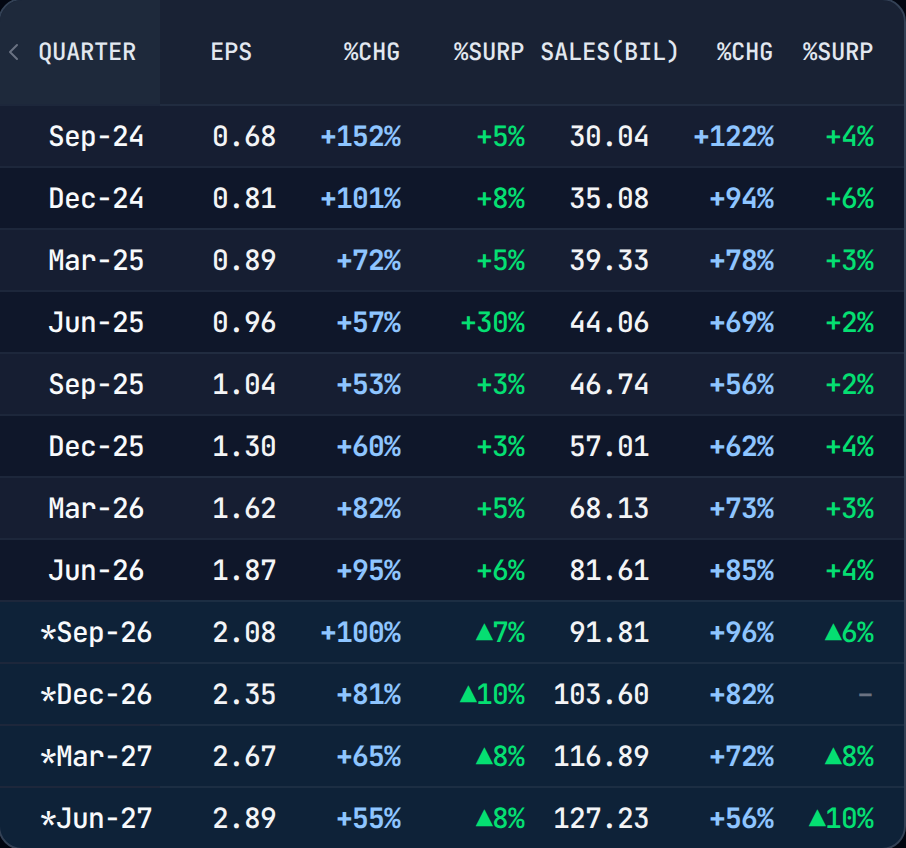
The “C” is the foundation of CANSLIM. O'Neil found that 75% of winning stocks showed at least a 70% increase in quarterly EPS before their major price advances. His minimum threshold: 25% year-over-year quarterly EPS growth.
Raw growth is not enough. You want acceleration. A company going from 15% EPS growth to 30% to 50% over consecutive quarters has the momentum that attracts institutional money. Decelerating growth (50% to 30% to 15%) is a warning sign even while the numbers stay positive.
Compare against the same quarter last year, never the prior quarter, so seasonality does not distort the number. Then check where the growth came from. Operating growth counts; one-time items, asset sales and accounting changes do not.
In EarningSpike
The EarningSpike earnings table shows 8 quarters of EPS with YoY % change. Green highlights flag positive growth. Look for consecutive quarters of accelerating growth in the “EPS Change” column.
Screen for 25%+ EPS growth stocks right now
The EarningSpike screener lets you filter by quarterly EPS growth, revenue acceleration, and more.
Open Screener →Annual Earnings Growth
One strong quarter can be an anomaly. The “A” criterion confirms that the company has a sustained track record. O'Neil looked for annual EPS growth of 25% or more over each of the past 3–5 years.
This filter eliminates companies that had one lucky year. Consistent annual growth shows that the business model is durable and that management can execute across different market conditions. O'Neil also checked that the company's return on equity (ROE) was at least 17%.
Strong quarterly and annual earnings together are what matter. One good quarter can be a turnaround story. Several strong years behind it mean a proven growth engine that is now accelerating.
In EarningSpike
Toggle to the annual view in EarningSpike to see year-over-year EPS growth across multiple fiscal years. Confirm that annual growth supports the quarterly trend.
New Product, Management, or Price High
Something “new” drives every major stock move. It might be a new product (the iPhone for Apple), new management (a turnaround CEO), or a new price high. A new high tells you the market has cleared its overhead supply and the stock is free to run.
Most investors make the mistake of buying on pullbacks or looking for “cheap” stocks. O'Neil's research showed the opposite: you should buy stocks emerging from sound bases into new high ground. A stock making a new 52-week high on heavy volume after a period of consolidation is a classic CANSLIM buy signal.
The catalyst doesn't have to be obvious at the time of purchase. Often, the “new” factor only becomes clear in hindsight. What matters is that the earnings are accelerating and the stock is confirming with price action.
Supply and Demand
Stock prices move based on supply and demand. O'Neil preferred a reasonable share count over mega-caps carrying billions of shares. A smaller float means that strong buying pressure translates into larger price moves.
Volume is the key signal here. On breakout days, you want to see volume surge to at least 40–50% above average. This confirms that institutions (mutual funds, hedge funds, pension funds) are accumulating shares. Light-volume breakouts often fail.
Share buybacks reduce supply too. When a company buys back its own stock while institutions accumulate, demand overwhelms supply.
In EarningSpike
EarningSpike shows what share of the float institutions hold, and whether that holding is rising or falling. Sign up free to see it.
Leader or Laggard
O'Neil measured leadership with Relative Price Strength (RS), which ranks a stock's performance against every other stock in the market. He required an RS Rating of 80 or above, meaning the stock is outperforming at least 80% of the market.
The logic is simple. Leadership is evidence. A stock with an RS of 90 is doing something right. Institutions are accumulating it, the business is executing, and the market is recognizing it. Stocks with low RS ratings are being sold or ignored for a reason.
Industry group leadership matters too. O'Neil found that roughly 37% of a stock's price movement is tied to its industry group. Focus on stocks in the top 20% of industry groups. When the sector lags, even strong individual companies face headwinds.
In EarningSpike
EarningSpike carries an RS Rating from 1 to 99 as a screener column and filter, and the Themes page ranks industry groups by how the typical stock in them is trading. Both cover this criterion, and both are part of Pro.
See what Pro includes →Institutional Sponsorship
You want stocks that institutions are actively buying. Mutual funds, pension funds, and hedge funds drive the big sustained moves because they buy millions of shares over weeks and months. Without institutional demand, a stock can't make a sustained advance.
Quantity is not the whole picture. Quality matters. O'Neil checked whether the stock was owned by top-performing fund managers. He also watched the trend of institutional ownership: is the number of institutional holders increasing quarter over quarter? That's a sign of accumulation.
Watch out for over-ownership. If every major fund already owns the stock, there may be no new buyers left. The sweet spot is rising institutional ownership with room for more funds to initiate positions.
In EarningSpike
EarningSpike shows institutional ownership changes: the number of holders, and whether they are adding or trimming. Look for rising sponsorship from quality funds. Sign up free to see it.
Market Direction
The “M” is the most important risk-management factor in CANSLIM. Three out of four stocks follow the general market direction. In a confirmed downtrend, even the best growth stocks get dragged down.
O'Neil tracked market direction by watching the daily price and volume action of the major indices (S&P 500, Nasdaq). He looked for distribution days, sessions where the index falls on higher volume than the day before, as signs of institutional selling. Four or five distribution days within a few weeks typically signals a market top.
A follow-through day points the other way: a strong rally on heavy volume, on day 4 or later of an attempted rally, signals a possible new uptrend. No bull market has ever started without one. Getting the “M” right keeps you in the market during uptrends and in cash during downtrends.
The Other Half of the System
Sell Rules & Risk Management
CANSLIM is as much about when to sell as when to buy. O'Neil was adamant about why most investors fail. They hold losers too long and sell winners too early. His sell rules are non-negotiable.
Cut Losses at 7–8%
If a stock drops 7–8% below your purchase price, sell it. No exceptions, no hoping for a rebound. This is O'Neil's most important rule. It keeps any single loss small and preserves capital for the next opportunity. Three out of four stocks that trigger this stop never recover to the buy point.
Take Profits at 20–25%
When a stock gains 20–25% from a proper buy point, consider selling at least a portion. This locks in gains while the stock is still strong. The math works in your favor: if you cut losses at 8% and take profits at 25%, you only need to be right one out of three times to break even.
Pyramid Into Winners
Don't buy your full position at once. O'Neil recommended adding to a stock only as it moves up from your initial buy point. Never average down. Start with half your intended position, then add in smaller increments as the stock proves itself. This concentrates capital in your best ideas.
Watch for Climax Tops
After a stock has run for weeks or months, watch for exhaustion signals: the largest single-day point gain since the start of the move, a price gap up on massive volume after an extended advance, or a sharp increase in the rate of price advance. These often mark the final stage before a major correction.
The sell discipline is what separates CANSLIM from a simple growth screen. Without it, one bad position can wipe out months of gains. O'Neil treated every buy as a hypothesis. If the stock does not confirm within a few weeks, move on.
Practical Walkthrough
How to Apply CANSLIM with EarningSpike
You don't need an all-in-one charting platform to apply CANSLIM effectively. The fundamental criteria are where EarningSpike specializes. Here's how to cover the key criteria:
1. Screen for Earnings Growth (C + A)
Use the EarningSpike screener to filter for stocks with 25%+ quarterly EPS growth. Then check each candidate's annual earnings view to confirm multi-year growth. This covers the two most important CANSLIM criteria in one step.
2. Verify Sales Growth (C)
On the earnings table, check that revenue is growing alongside EPS. Strong EPS growth without revenue growth usually points to cost-cutting or buybacks, and neither lasts. O'Neil wanted to see at least 25% revenue growth in the most recent quarter, or accelerating sales growth over the prior three quarters.
3. Check Institutional Ownership (S + I)
Review the institutional ownership section for each stock. You want to see a rising number of institutional holders with net buying activity. This confirms both the supply/demand dynamics (S) and institutional sponsorship (I).
4. Confirm with Insider Activity
While not part of the original CANSLIM formula, insider buying adds conviction. Check whether executives are buying their own stock, especially ahead of earnings. EarningSpike's insider transaction view shows recent buys and sells by role.
5. Monitor Your Watchlist
Build a watchlist of stocks passing your CANSLIM fundamentals criteria. Then wait for the right technical setup (base breakout on volume) and the right market direction (M) before buying. Run the screener weekly during earnings season to catch new candidates.
Common Questions
FAQ
Does the CANSLIM method still work?
Yes. The core principles hold up: strong earnings growth, institutional sponsorship, and market leadership. Decades of use have tested them, and the emphasis on earnings acceleration is backed by academic and practitioner research. What decides the outcome is disciplined application, above all on the sell side.
What tools do CANSLIM investors use?
CANSLIM investors commonly use MarketSurge (formerly MarketSmith) for IBD ratings, or EarningSpike for affordable earnings acceleration tracking, insider activity, and institutional ownership data. The key requirements are access to quarterly EPS data, revenue growth, and institutional ownership changes.
How is CANSLIM different from value investing?
Value investing seeks undervalued stocks trading below intrinsic worth (low P/E, low P/B). CANSLIM is a growth momentum strategy that buys stocks with accelerating earnings, rising institutional ownership, and strong price action, often at higher valuations. Value investors buy cheap. CANSLIM investors buy strong.
What is the minimum EPS growth for CANSLIM?
O'Neil's original criteria call for a minimum 25% year-over-year quarterly EPS growth (the “C” in CANSLIM). For annual earnings (the “A”), he looked for 25%+ growth over the past 3–5 years. The best candidates often show 50–100%+ quarterly growth.
Can beginners use the CANSLIM method?
Yes, though it requires learning to read earnings data and price charts. CANSLIM is systematic and rule-based, which makes it easier to learn than approaches built on judgement. Start by screening for the “C” and “A” criteria using an earnings tool, then layer in the other factors as you gain experience.
How many stocks should a CANSLIM portfolio hold?
O'Neil recommended a concentrated portfolio of 4–8 stocks. CANSLIM is a high-conviction strategy: a handful of names with the strongest fundamentals and technicals. Position sizing and cutting losses at 7–8% carry the risk control.